Theocracy flying city
Awakening the Angel System: Apocalypse: A LitRPG Progression FantasyTheocracy flying city is a mobile Paladin fortress whose importance changes as the world disintegrates around it. It begins as a symbol of sacred protection and military power, becomes the emergency capital and shelter of a displaced population, and ends by falling into the sea after Jack activates its kill switch. Its trajectory concentrates the book’s recurring conflict between protection and control: the city can preserve human life, but it can do so only through contested authority, scarce resources, and the dangerous concentration of survivors within a single airborne stronghold.
Definition and Military Function
Theocracy flying city is a floating city controlled by the Theocracy and defended by its Paladins. Its religious authority is expressed through the protection associated with Saint Citri: Lita argues that Hoshido remains safe because Lord Jack requested the city’s blessing, and that without this protection its inhabitants would succumb to the poison blighting the world. The city is therefore more than a transport platform. It is a sacred shield, a military base, and a political instrument whose protection gives the Theocracy leverage over the people living beneath it.
That protection becomes especially concrete during the preparations around Zanzibar. The city hangs high overhead as an aerial countermeasure against the never-ending attacks, offering defense while Jack’s forces judge who can join the expedition. Its height gives the defenders an advantage against demonspawn and Apostles, but also turns the city into a visible center of survival. Rumors spread about the flying city that keeps the hordes at bay, even though Selfia has not broadcast its location. The fortress thus attracts the very refugees and threats that make its defense necessary.
Refuge, Capital, and Logistical Burden
When Lunacrypt Capital becomes a cesspool of dead bodies, demonspawn, and abandoned debris, Selfia is forced to move her base of operations away from the Apostle invasion. Theocracy flying city provides housing and protection for the thousands who follow her, becoming the refuge for a population displaced by a threat not seen since the founding of the Imperium. The relocation is not a simple evacuation. Millions of Imperial citizens and vast quantities of infrastructure must be displaced, while no single ordinary city can accommodate them. The flying city becomes the only available shelter capable of receiving a significant portion of this movement.
Its role as refuge creates immediate political and material strain. Food is scarce, ammunition and replacement parts are running short, and nomad, Paladin, and Imperial survivors feud over supplies and authority. Lita insists that Paladin warriors require food because they form the bulwark against the demonspawn and the Apostles probing the city’s defenses. Kenichi counters that miners and workers need those provisions to produce ammunition and materials, and that demanding tithes makes the Paladins resemble invaders. The city’s promise of protection therefore does not erase social hierarchy; it intensifies disputes over who deserves to eat, who controls labor, and whose contribution counts as essential.
Selfia’s own forces bring supplies and materials, but the constant refugee influx and repeated attacks drain those reserves. The city’s defensive value makes it a magnet for people seeking safety, while every new arrival increases the burden on the fortress’s food stores, manufacturing capacity, and internal order. Its function as a sanctuary is consequently inseparable from a crisis of distribution. The city protects a community that may be unable to sustain itself, and its sacred legitimacy must continually compete with the practical demands of survival.
Community and Expeditionary Base
During the two-day period in which Jack conducts judgments to eliminate the helpless and useless from the expedition, a massive fleet gathers beyond Zanzibar. The assembled force includes landships, airships, and caravans, with refugees following the trail of supplies entering the region. Demonspawn follow them as well, and Apostles butcher many refugees before Sahaqiel and Selfia’s teams can intervene. In this setting, Theocracy flying city serves as an aerial countermeasure and shield while the ground around Zanzibar becomes covered with the corpses of both humans and demonspawn.
The fortress also houses Jack’s loved ones and the entire community of Hoshido. Airships are converted into shelters and storage facilities for the expedition, extending the city’s protective function into a wider network of vehicles and temporary living spaces. It is simultaneously a military asset, a refugee camp, a storehouse, and a home. That combination explains its emotional importance: its fall threatens not only an army’s defensive position but also the concentrated community Jack is trying to protect.
The city’s presence also links personal and collective stakes. Jack’s decisions about the expedition occur under the knowledge that his loved ones and Hoshido’s people are aboard. The airborne refuge is therefore part of the practical machinery of war, but it is also the visible container of the life he hopes to preserve. Its defenses make survival possible; its crowded interior makes every shortage and political conflict immediate.
Political and Bodily Power
Theocracy flying city repeatedly appears beside systems that treat bodies as instruments of power. Its protective status is invoked to justify demands on workers and civilians, while its military purpose places Paladin bodies in continual combat against demonspawn and Apostles. The city’s authority is not neutral: protection is exchanged for obedience, supplies, and recognition of sacred jurisdiction. The dispute between Lita and Kenichi exposes this structure. Lita presents the city’s protection as a moral claim to food; Kenichi sees the demand as an invasion of Hoshido’s labor and land.
The fortress also forms part of a wider world in which bodies are endangered, modified, or occupied. At one point Tangerine reaches the cockpit of a Khloros and discovers a green-haired girl, not even a teenager, strapped into wires, machines, and fleshy tendrils, her body marked by black veins. Elsewhere, Lilith produces a flickering green-and-red orb that Jack recognizes as a soul, and Michael explains that the body of Jack’s father has been commanded while Jack’s sister has been subjected to experimentation. These scenes do not establish that the city itself performs those transformations, but they place its protective machinery within the same political landscape: survival depends on institutions that organize, shelter, weaponize, and sometimes appropriate vulnerable bodies.
The city’s sacred protection likewise coexists with emergency violence elsewhere in the Empire. Selfia admits that a purge has killed three hundred and sixty-nine people, possibly more, including political opponents, rivals, and dissidents, in the name of securing the New Republic. Jack condemns the resulting chaos because hundreds have died, including bystanders and innocents, and because Ada’s pregnancy and his unborn child have been placed in danger. Against that background, the flying city’s promise of safety remains morally unstable. It can genuinely defend refugees while existing within a political order that repeatedly converts protection into a justification for coercion.
Fall and Narrative Significance
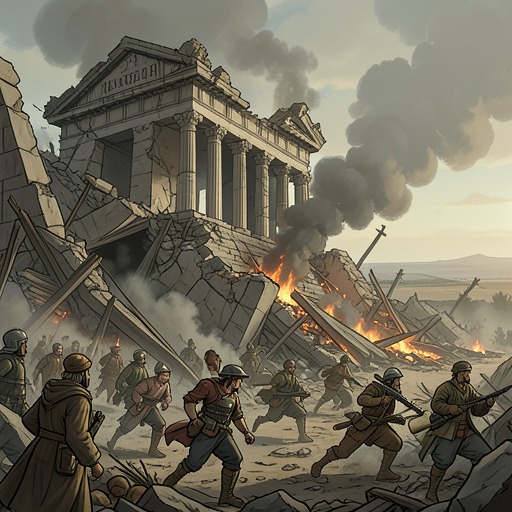
Theocracy flying city’s decisive ending comes after Jack activates the kill switch. Ada asks what the switch means as the distant city crashes into the sea. Selfia turns from the ocean and observes that the landscape is now free of the corruptive purple smog, while thousands of confused people in outdated uniforms and armor stand around her. The city’s destruction is therefore both a loss and a threshold. The fortress no longer shields the surviving population, but its fall accompanies the disappearance of the environmental corruption that had made such protection necessary.
The ending also separates the city’s material history from Jack’s transformation. After five years of absence, Jack returns with six wings—two silver, two white, and two black—while Sahaqiel stands behind him and a raven-haired little girl accompanies them. Celeste recognizes him as her father, and Ada recognizes him as Tanji only after focusing on the changed figure. The airborne fortress has fallen, yet Jack appears in a form that makes the old systems of protection and identity seem inadequate. The city once held the community above the poisoned world; after its crash, survival must be confronted on altered ground.
As an object, Theocracy flying city embodies the contradiction of wartime refuge. It offers a literal elevation above catastrophe, protects Hoshido and the expedition, and gives displaced people a place to gather, but it cannot escape scarcity, factional conflict, or the violence of the political systems that depend on it. Its movement from sacred stronghold to overcrowded capital to falling wreckage mirrors the collapse of institutional guarantees. The city’s final descent does not simply close an episode of military history; it announces that the old architecture of protection has ended, leaving the survivors to face a world newly cleared of smog but stripped of the fortress that once kept the hordes at bay.